Agentic Coding is reshaping AI-assisted software development by combining intelligent automation with structured workflows, engineering discipline, and human oversight.
As artificial intelligence continues to improve at writing code, we are seeing a massive surge in “vibe coding.” The process feels almost magical. You come up with an idea, feed it to an AI, and a fresh project materializes almost instantly.
This rapid generation leads to a common yet dangerous assumption. People start believing engineering is dead and AI can do it all.
I have watched senior engineers delegate complex tasks entirely to AI. The feature gets built, but it leaves behind a messy codebase riddled with technical debt. Worse, the engineer becomes completely out of touch with their own architecture. The debt compounds until the system inevitably collapses. When it does, the blame falls on the engineer instead of the AI.
However, engineers should absolutely not shy away from using AI. It is a powerful tool with the potential to multiply your efficiency. It removes the friction of switching between frameworks, and it drastically cuts down the time spent on boilerplate, tests, and accessibility features.
The secret lies in treating AI as a collaborative coding partner. It is not a senior engineer that dictates your architecture, nor is it a junior intern that blindly executes tasks. The human must remain in the loop.
This partnership is the core of agentic coding and effective AI-assisted software development.
At Consint.ai, this perspective aligns with our broader approach to building intelligent, enterprise-focused technology. As AI becomes increasingly embedded in software development, the emphasis extends beyond accelerating code generation to creating systems that are reliable, scalable, and designed for long-term value. Human expertise, structured engineering practices, and responsible AI adoption remain central to that approach.
Vibe Coding vs. Agentic Coding: Understanding the Difference
The quality of AI output does not rely solely on the underlying model. I have seen poor results from premium models like Claude Opus, and I have seen incredible results from generous free-tier models like Gemini Flash. The deciding factor is always the input and the workflow.
Vibe coding is “prompt-and-pray”: throwing an idea over the wall and hoping the AI gets it right. It lacks context and relies on the AI to guess the architecture.
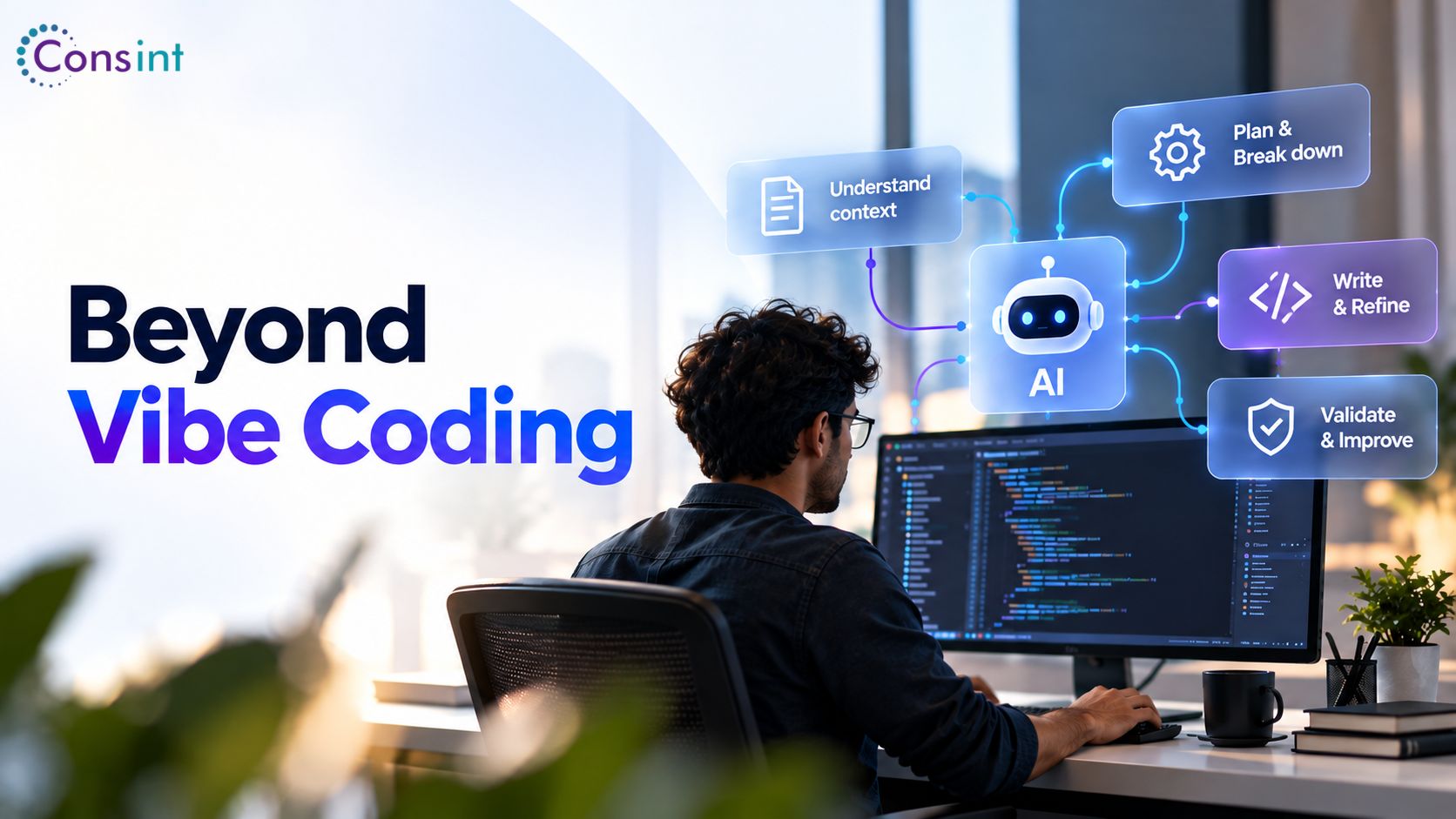
Agentic coding treats software development as a structured, iterative dialogue between the engineer and the AI. It relies heavily on local codebase context, structured instructions, and rigorous guardrails.
How to Build an Agentic AI Coding Workflow?
Here is how you can transition from simple vibe coding to a robust agentic AI workflow for software development.
1. Provide Context and Repository Rules for AI Coding
Without sufficient context, AI models hallucinate. This is why CLI coding agents and deeply integrated IDE tools outperform standard web LLMs. They can index your entire repository and read the actual file tree.
You can improve AI output by providing reusable instructions via Markdown files. These are often called “skills” or repository rules. By defining your tech stack, formatting rules, and architectural preferences in a static file, you save tokens and prevent the AI from making wrong assumptions.
2. Research and Diagnose
Whatever you want to accomplish should be broken down into smaller steps.
If you are developing a new feature, start by brainstorming with your agent. Refine your idea, ask the AI to identify edge cases, and discuss alternative technical approaches. The AI is excellent at keeping up with your thoughts and pointing out blind spots.
If you are debugging a complex issue, do not just paste an error and say “fix this.” Ask the AI to diagnose the root cause first. Share your own insights and point the agent toward specific files that might be the source of the bug.
3. Granular Deliverables and TDD
Once the research phase is complete, break the implementation down into small deliverables. This prevents the engineer from losing touch with the codebase.
Always supplement this implementation with Test-Driven Development (TDD). TDD is the ultimate guardrail for AI. Tell the AI what to build, ask it to write the failing tests first, and then have it write the implementation to make the tests pass. This test-driven development (TDD) process gives the AI clear criteria for what success looks like. It also bulletproofs your implementation against future feature additions breaking legacy code.
4. Setting Up Automated Guardrails to AI-Generated Code
When working with AI, human oversight is not enough. You need automated pipelines to keep the AI in check regardless of the language or framework you are using.
For example, when I work on a TypeScript project, I always set up a strict pre-commit hook using tools like Husky. This pipeline ensures the code is formatted, linted, and compiled without errors before it ever gets staged. The exact same principle applies to Python with pre-commit and Ruff, or Go with golangci-lint.
If the AI generates buggy code, the pre-commit pipeline fails. The AI reads the terminal error, fixes its own mistake, and tries again. With these guardrails in place, your AI partner is forced to write compliant and error-free code before committing.
Why Software Engineering Fundamentals Matter in Agentic Coding?
As AI integrates into every developer’s workflow, knowledge of computer science fundamentals becomes more important rather than less. AI can handle the mundane abstraction of writing syntax, but the architectural fundamentals are bound to the human. Concepts like SOLID principles, Test-Driven Development, and design patterns used to give structure to programs written by humans. Today, they give structure to code generated by AI. Ultimately, AI code improves tremendously when guided by these paradigms, and it is up to the human engineer to enforce them.
Building Enterprise AI with Engineering Discipline
At Consint.ai, we work across AI-powered risk intelligence, intelligent transaction management, and connected healthcare technology, where building reliable and scalable solutions matters as much as the technology behind them.
As AI becomes a bigger part of software development, writing code faster is only one part of the equation. Understanding the architecture, maintaining code quality, testing thoroughly, and keeping engineers involved in critical decisions are equally important.
For us, the real value of AI-assisted development lies in combining the speed of AI with sound engineering practices to build solutions that are not only efficient today but also ready to evolve with changing business needs.